

🕸️In the Interstitial Space
Part of The Listening Series — reflections on what it means to sense, attune, and respond within living systems.

In systems change, we often focus on the visible — strategies, structures, outcomes. Yet transformation is just as dependent on the spaces in between: the interstitials where relationships form, ideas travel, and trust grows. This piece reflects on my own journey to find language for that work — and how tending to these unseen connections might just be what keeps the whole system alive.
For years I tried to find the language to describe the ways in which I show up in community, to convey how I work or what my role is.
I remember during my years in public service describing myself as the connection, the “rub,” between the triangle of hierarchy (government) and the circle of community, always working to bridge relationships and opportunity. Sometimes I’d explain my work by listing the themes I focused on: housing, early learning and care, food security, mental health and substance use, poverty, equitable access to transit, recreation, accessibility planning, and accommodation. And yet, it never felt quite right. Something was missing.
When I stepped into consulting, my pitch became more specific. I leaned on examples from government and described the areas of social development I was familiar with. It still didn’t feel right. The language was linear, indicator-driven. It couldn’t hold what mattered most to me: the relational, the in-between, the unseen.
One day, I realized I needed to be more curious with myself and listen for other languages that might better describe how I see and move in the world.
In 2023, I attended a global conference on poverty reduction, Opportunity Collaboration. It brought together people from across the world, each speaking from a deep sense of place and purpose. It was the first time I heard many others describe their contributions through words like connection, land-based practice, breath work, and network weaving. A little crack in my own narrative began to form. I felt a kind of communion with these people—an ease in my body when I heard their words. They were speaking a language I somehow already knew.
That experience invited me closer to something I couldn’t yet name.
In 2024, I entered a nine-month fellowship, an invitation to examine my edges, renew my relationship with myself, and embrace mystery and the land. It was a wildly transformative experience. I began to see that the way I show up is not linear and not easily defined. It is something that must be observed.
There was a moment during the fellowship when I found myself standing in the forest blindfolded with a partner, trying to locate a place I had been before. I realized that on my previous visit that day I had relied only on sight—the visible markers of the trail, the familiar curve of the path. This time, I was required to draw on other senses to find my way. I let the smell of damp cedar and the texture of moss and sticks beneath my bare feet guide me; I listened in a new way to find the tree I had previously seen only with my eyes.
It was a profound experience, tapping into parts of myself I hadn’t consciously trusted before. I began to understand that knowing doesn’t always come through the eyes or the mind. Sometimes it comes through the body, through attunement and quiet trust in the unseen.
In those months, I practiced deep listening in the forest—noticing small cues and patterns, hearing stories carried by the wind, sensing subtle shifts in the soil and canopy. It mirrored how I’ve learned to listen in community: attending to what’s moving beneath the surface, what’s trying to find expression, what needs care to grow.
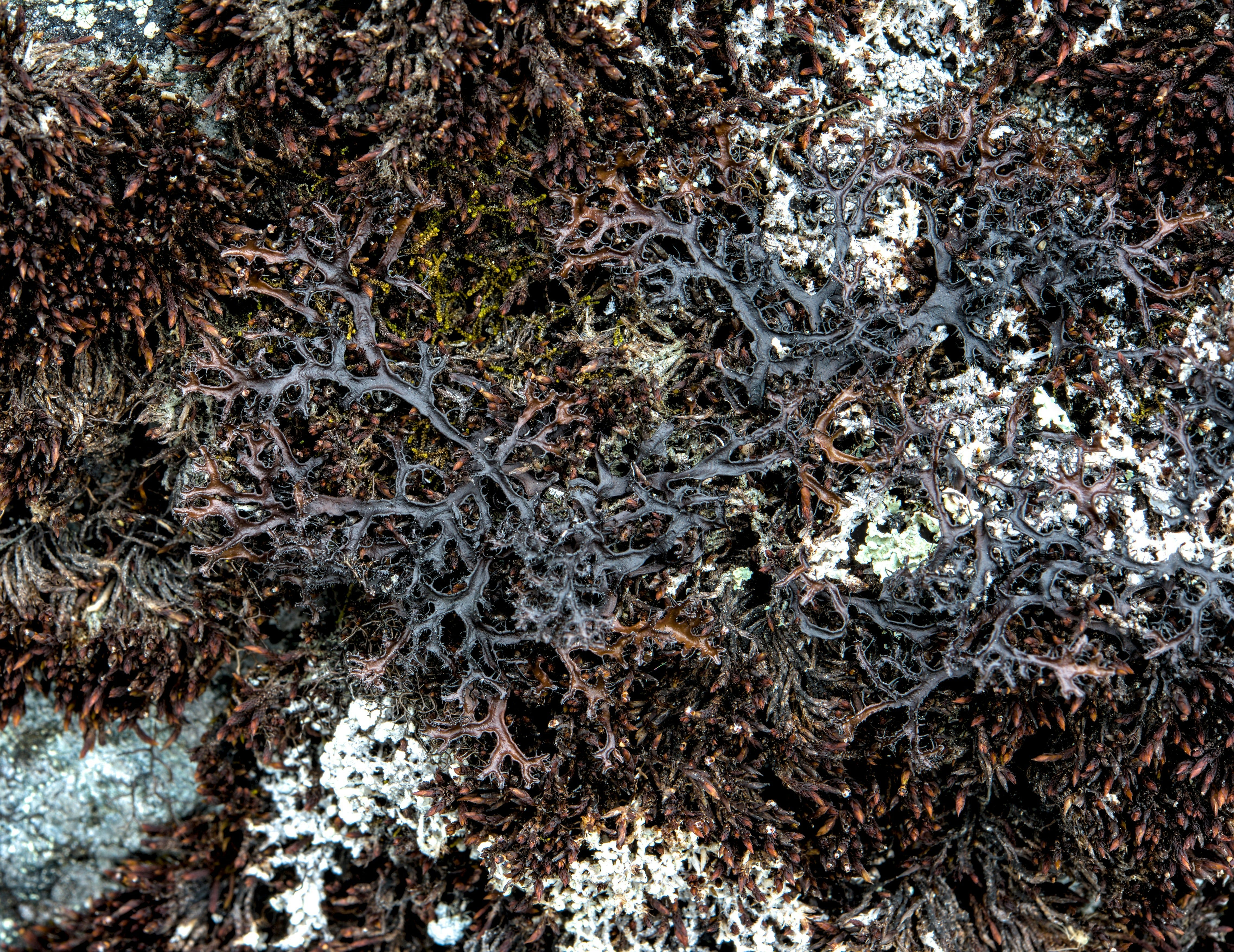
As I studied the forest, I began to notice how ecosystems take care of themselves through a complex web of relationships. I became fascinated with what happens below the surface, how the mycelial network contributes vital intelligence to the system above ground. These observations vibrated through me like the pull and release of a tree branch. Never before had I felt so connected to my role in our human ecosystem.
Upon this realization, interesting things began to happen. I started finding others who were talking about these unseen roles—the weavers, the connectors, the stewards of relational space. I came across articles describing the importance of people who act like mycelium, carrying signals, stories, and nutrients through the social soil. Then came the words interstitial and connective tissue. With each new conversation and reference, I felt closer to understanding my place in the ecosystem of change.
I’ve come to see that the interstitial space is often where the conditions for transformation and change are created. It’s the quiet terrain where energy, ideas, and relationships circulate, where the seed of an idea might be planted in one conversation and later germinate in another.
This has happened many times in my career. Through the information, stories, and signals that move through my work, a kind of noticing takes place—a pattern recognition that lends itself to curious questions and small sparks of possibility. I share these sparks with others, knowing they may take on new life elsewhere.
In ego-driven systems, that can feel uncomfortable. When ideas move through others and find traction, it can seem as though they’ve been taken or claimed. But that perspective belongs to a world still oriented around ownership and scarcity. The interstitial work I care about isn’t about holding or claiming; it’s about flow, contribution, and collective intelligence.
That said, attribution still matters. Naming where ideas come from is a small but vital act of equity. It honours the relational lineage of insight—the many hands, hearts, and histories that make collective change possible.
Recently, I was reminded of this in a network I’d just joined. I had a rich, generative conversation with the chair, sharing an idea about a new way to frame our advocacy efforts. Later, that idea was brought to the larger group, where it resonated and gained momentum. But there was no mention of our earlier exchange.
It’s a simple story, but it lingers. On one hand, I can see how my contribution helped create conditions for change—an interstitial moment where something moved through me into the system. On the other, I notice how our structures still struggle to recognize this kind of relational work. In spaces where ego and hierarchy are the dominant currencies, the quiet work of weaving can go unseen or misinterpreted as self-promotion.
This is the paradox of being the connective tissue. The role requires both humility and discernment, tending to ideas as they move through while gently reminding the system that the mycelium matters too.
Because what happens in the interstitial space shapes the health of the whole.
If you’d like to support the continued weaving of Mycelium Notes, you can buy me a coffee. Every small gesture helps nourish the writing and reflection that live here. Thank you.
Reflective Invitation
As you reflect on your own experience within systems of change—whether in organizations, communities, or networks—consider:
Where have you witnessed the interstitial space at work: those unseen connections, quiet collaborations, or acts of relational tending that shaped an outcome in ways that data couldn’t measure?
Who are the mycelial actors in your ecosystem: the people holding relationships, translating between worlds, or sensing what’s emerging beneath the surface?
How might we better acknowledge, resource, and celebrate these roles—not as soft skills or invisible labour, but as essential functions that sustain the health of the whole?
What becomes possible when we treat the interstitial space not as a gap to be filled but as fertile ground for transformation?
If you, too, are curious about what it means to listen across systems and sense what’s emerging beneath the surface, you can subscribe to Mycelium Notes and join me in this unfolding conversation.
Beautiful, Jen!